The Role of Technical and Fundamental Analysis in Share Trading Courses
Legacy signals
Legacy popularity: 420 legacy views
Technical and fundamental analysis are two fundamental pillars of share trading courses, and they play distinct but complementary roles in helping traders make informed investment decisions. Here's an overview of the role of each in share trading education:
1. Technical Analysis:
Technical analysis involves studying historical price and volume data, as well as chart patterns and technical indicators, to forecast future price movements. The primary focus of technical analysis is on the market's behavior and price action. In share trading courses, the role of technical analysis is as follows:
-
Price Prediction: Technical analysis helps traders predict future price movements, identify trends, and potential entry and exit points for trades.
-
Risk Management: By analyzing charts and indicators, traders can set stop-loss orders and establish risk-reward ratios to manage their positions effectively.
-
Timing Trades: It helps traders time their trades, identifying optimal moments to buy or sell shares based on technical patterns, support and resistance levels, and momentum indicators.
-
Psychology: Technical analysis also touches upon the psychology of trading, including the impact of crowd behavior and emotions on market movements.
-
Charting Tools: Share trading courses often teach how to use charting software and trading platforms to apply technical analysis effectively.
2. Fundamental Analysis:
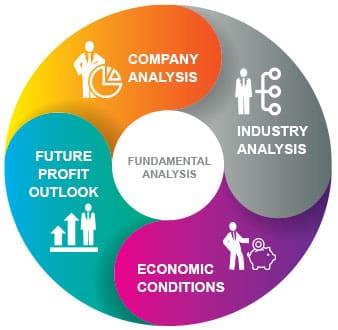
Fundamental analysis focuses on evaluating the intrinsic value of a stock or asset by examining financial and economic factors that can impact its future performance. In share trading courses, the role of fundamental analysis includes:
-
Company Valuation: It teaches how to assess the financial health and prospects of a company by analyzing financial statements, earnings reports, and other company-specific data.
-
Economic Indicators: Fundamental analysis covers the impact of economic indicators, such as GDP, inflation, and interest rates, on the broader market and individual stocks.
-
Industry and Sector Analysis: Traders learn to evaluate industries and sectors, considering factors like growth potential, competitive dynamics, and regulatory influences.
-
Investment Decisions: Fundamental analysis helps traders make long-term investment decisions by identifying undervalued or overvalued stocks.
-
Dividend and Income Investing: For income-focused traders, fundamental analysis plays a crucial role in selecting stocks with strong dividend yields and growth potential.
In share trading courses, both technical and fundamental analysis are typically taught to provide a well-rounded and comprehensive approach to trading and investing. Traders often use a combination of these methods to make decisions. For example, they might use fundamental analysis to identify strong long-term investment opportunities and technical analysis to determine entry and exit points for shorter-term trades.
Ultimately, the choice of which analysis to prioritize depends on the trader's goals, trading style, and the specific assets they are trading. Many successful traders incorporate elements of both technical and fundamental analysis into their strategies to gain a deeper understanding of the markets and improve their decision-making abilities.
Further reading
Further Reading
Video
Investing 101: What Every Beginner Needs to Know
A clear, jargon-free introduction to investing principles for first-time investors.
March 29, 2026
Article
What Affects Truckload Shipping Costs?
Truckload shipping is a cornerstone of modern supply chains, responsible for moving goods efficiently across regional, national, and international networks. For businesses that rely on timely deliveries, understanding what influences truckload shipping costs is essential for optimizing logistics budgets and maintaining operational efficiency. Costs associated with truckload shipping can vary widely depending on several factors, from cargo type to route optimization. By analyz
January 7, 2026
Article
The Unlikely Call Center: Why the World is Dialing into Pakistan
Imagine itâs a typical Tuesday evening. Someone in a bustling North American city has a question about their internet bill. They pick up the phone, dial a familiar customer service number, and within moments, theyâre connected to a calm, articulate agent who resolves their issue efficiently. What the caller might not realize is that the helpful voice on the other end is speaking from a modern office in Lahore or Karachi, halfway across the globe. This scenario is playing
November 19, 2025
Article
How Qualified Solar Leads Can Improve Your Conversion Rate
Introduction: The Changing Face of Solar Sales In the fast-evolving world of renewable energy, the solar industry has witnessed remarkable growth. But with that growth comes competition â and not just for customers, but for the right customers. Many solar companies are discovering that chasing countless leads doesnât always bring better results. What truly matters is the quality of those leads. A well-qualified lead isnât just a number on a list; itâs someone genuinel
October 29, 2025