Benefits of Letting Go Discoverable in Therapy
Reader stats
Article rating
New ratings
Reader rating appears publicly after enough eligible article ratings.
Rate this article
Sign in to rate this article.
Letting go of someone we love is never easy. Letting go allows us more freedom in our lives and helps us stop controlling behavior. It might mean letting go of someone who is self-destructive, like an addict. Fundamentally, we’re powerless over someone else. Letting go may feel unloving, but it actually allows us to love with compassion instead of manipulation. Letting go might prepare us to want to leave a relationship or get over someone who has hurt us or left us.
It can be extra hard for codependents to let go, especially if you have low self-esteem and tend to isolate, rather than seek the support of friends and family.
Benefits of Therapy
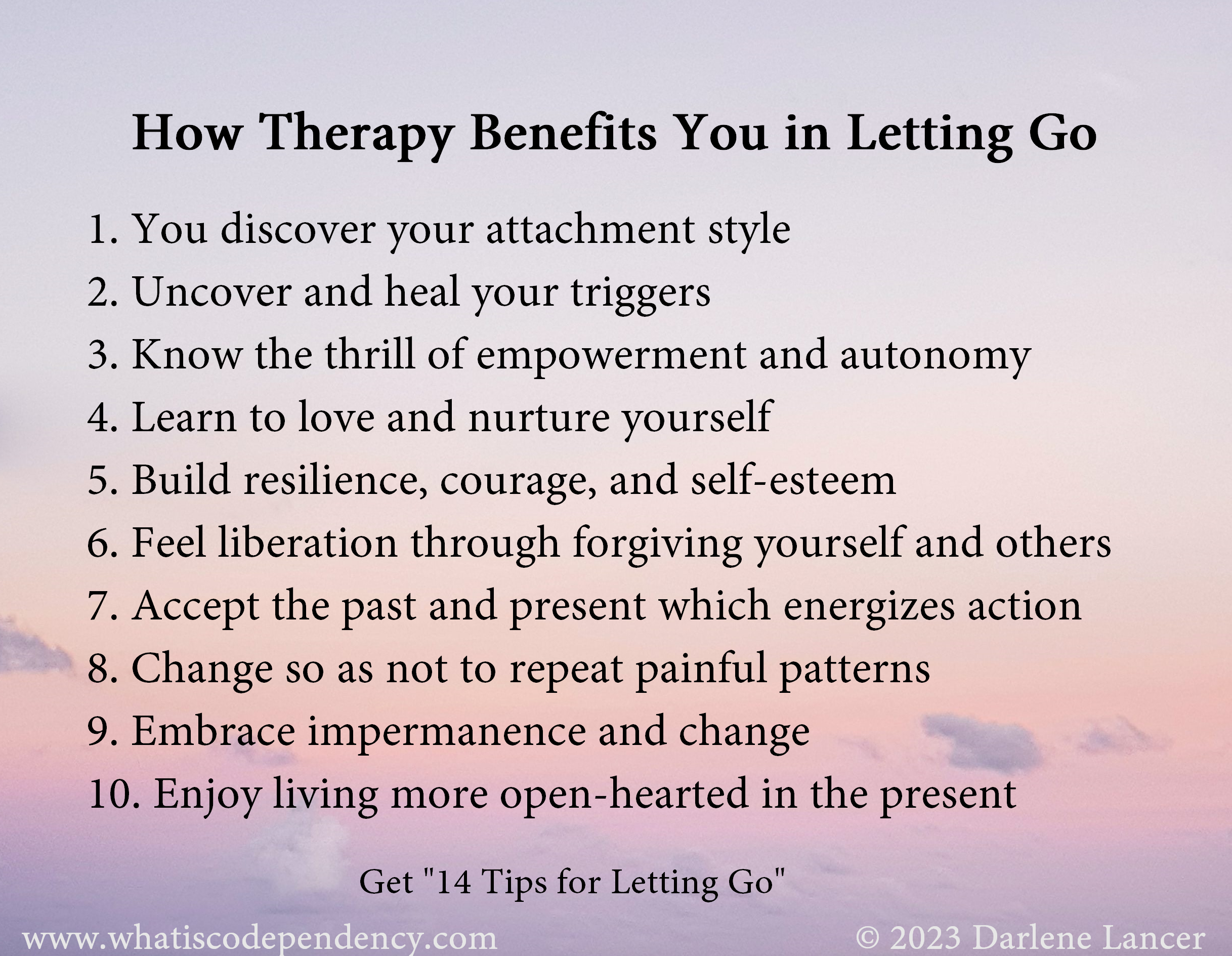
In the process of letting go, in therapy, you learn some of the following unexpected things. You:
1. Discover your attachment style
Often we find that events in our childhood can either help or hinder how we attach and our ability to let go. If we've been emotionally abandoned, which is true for most codependents (even with an intact family), that trauma will influence our attachment style, the type of person we bond with, and whether we're able to let go.
2. Uncover and heal your triggers
Our past experiences, especially with our parents, may leave wounds that get triggered in the present time. They can make it hard to let go. In therapy, we can uncover those triggers and heal the underlying wounds. This provides us greater freedom to respond, not react, detach, and let go.
3. Know the thrill of empowerment and autonomy
By getting support in therapy to take risks and act more independently, we're able to set boundaries and take life-affirming actions. We feel exhilarated in finding our freedom and owning our power.
4. Learn to love and nurture yourself
By instruction and example in therapy, we learn how to nurture and love ourselves. This makes us less needy of others and also helps us manage the grief and fear associated with letting go. Get the Self-Love Meditation.
5. Build resilience, courage, and self-esteem
By having support, minimizing our fears, and trying out new behaviors in therapy, we gain the courage to try out new behaviors in our lives.
6. Feel liberation through forgiving yourself and others
When we're in pain, it's tempting to get stuck in self-blame, guilt, or shame, about past actions or inactions. In therapy, our assumptions and beliefs are challenged. We can experience empathy and forgiveness for ourselves. Empathy for ourselves prepares us to forgive others. We realize that our anger and resentment hurt us above anyone else.
7. Accept the past and present which energizes action
We may be in denial and stuck in a current or past relationship. It also feeds trauma bonds that make it harder to leave abusive relationships. By forgiving ourselves and sharing and understanding our feelings, we release blocked energy and are able to be more present.
8. Change so as not to repeat painful patterns
In therapy, we can identify self-destructive repetitive patterns in our behavior and relationships so that we don't repeat them. As a result, we behave and decide differently in the future.
9. Embrace impermanence and change
We learn that we cannot always control other people and reality to our liking. We realize that the one thing that is constant is change. All life is impermanent. By embracing that concept and accepting reality, we can live with more ease.
10. Enjoy living more open-hearted in the present
Once we've released painful emotions and let go of things we can't control, we're able to live with less fear, put our energy into creating the life we want, and open our hearts to what the present brings.
Letting Go
Detaching starts with understanding, but it takes time for the heart to really accept that ultimately we’re powerless over others and that our efforts to change someone are unhelpful and possibly detrimental to us, the other person, and the relationship. Read more about detaching and take a quiz to determine if you're over-involved. Practice these techniques to help you let go. Join my mailing list to get "14 Tips for Letting Go."
© Darlene Lancer 2024
Article author
About the Author
I'm a Licensed Marriage and Family Therapist and author of Dating, Loving, and Leaving a Narcissist: Essential Tools for Improving or Leaving Narcissistic and Abusive Relationships," Conquering Shame and Codependency: 8 Steps to Freeing Your True Self and Codependency for Dummies. and the 7 ebooks, including 10 Steps to Self-Esteem: The Ultimate Guide to Stop Self-Criticism, Spiritual Transformation in the Twelve Steps, "I'm Not Perfect - I'm Only Human" - How to Beat Perfectionism, Freedom from Guilt and Blame - Finding Self-Forgiveness, and How to Speak Your Mind: Become Assertive and Set Limits.
I've worked with countless individuals and couples for more than 35 years to recover from trauma and codependency. I'm an expert on narcissism, relationships, and codependency. See www.whatiscodependency.com and www.darlenelancer.com. See my website for FREE podcasts, meditations, and resources.
I've helped many individuals and couples find their way to more productive lives, happier marriages, and also to amicably separate.
My training includes psychoanalytic psychotherapy, EFT, family systems, trauma work, cognitive-behavioral, dream analysis, gestalt, and hypnotherapy.
I maintain a private practice in Santa Monica, and coach people internationally. See my website Service page for more information. Consultation by appointment: 310-458-0016. See my website to get a free report on 14 Steps for Letting Go.
Further reading
Further Reading
Article
Live A Happy Married Life by Resolving Conflicts in Marriage
Param Pujya Dadashri and Hirabaâs married life was full of peace, mutual respect and humility. Their worldly conduct and interactions were idyllic, so much so that family and friends noticed their unity and love for each other. For instance, Hiraba would visit the local vegetable market daily, she would ask Param Pujya Dadashri, âWhat vegetables should I buy?â Thus, performing her duty of asking and He would reply, âBuy whatever you would like, therefore fulfilling Hi
April 3, 2025
Article
A Look at Avoidant Attachment Styles and How They Work
The early development of avoidant attachment creates a coping mechanism that forms in childhood. Disconnected parent-child interactions typically trigger this condition. People who develop this attachment style learn to depend on their resources. They avoid deep emotional connections. People with this attachment style want intimacy, yet they remain afraid of becoming dependent on others. Understanding Avoidant Attachment Among the four primary attachment styles, avoidant atta
February 6, 2025
Article
Do You Really Understand The Swinger Life-Style?
So, you want to Play swinging? Do you like the idea of having sex with several attractive people, with no strings attached? Want the chance to explore your fantasies with like-minded people? Love having the intimacy and long-term commitment of your partner, but don't want to miss out on the opportunity for sexual exploration and variety? If this sounds like something you'd like to try, the increasingly popular lifestyle known as 'swinging' could be for you. What's so shocking
August 29, 2024
Article
Best Swinger Websites for Couples Looking for Local Swingers
Even if you don't have a swing club near you, the online swinger dating website is a good choice for you. In recent years, online dating sites have become increasingly popular, and swinging has become one of the most popular lifestyles for married couples and bisexual people. If you are looking for a swinger couple, here are some swinger dating websites where you can enjoy an adult swing. Adult Friend FinderrnAFF is the worldâs largest sex community and swinger dating site.
August 29, 2024