Codependency is based on Fake Facts
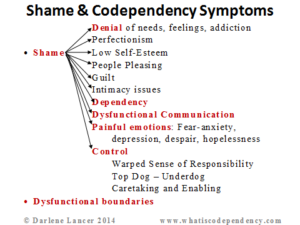 Codependency is based on a lie. Its symptoms develop to cope with the deep, but false and painful belief – that “I’m not worthy of love and respect.” In the chart to the left, core symptoms of codependency are in red, but nearly all the symptoms revolve around shame – the shame that accompanies rejection. This entire system operates beneath our awareness, and until we know it and feel it, we’re caught in its grip.
Symptoms of Codependency
The symptoms of codependency are either caused by shame or are or are defenses to feeling shame, as explained in Conquering Shame and Codependency. Most codependents grow up feeling ashamed of their real feelings, wants, and/or needs. As adults they deny, devalue, and/or don’t express them to avoid their shame. Some people can’t identify them at all, and willingly put those of others first. This leads to anxiety, depression, obsessions and addictive behavior. Later, they feel anger and resentment or hurt and uncared about. Especially during courtship, they accommodate and please in order to be loved by someone to avoid a breakup. Once married, there’s often disappointment when the relationship feels unequal.
Shame is a feeling that leads to self-destructive thoughts and negative self-evaluations, which produces low self-esteem. Self-esteem isn’t so much a feeling, but how we think about ourselves. When we have toxic shame and make a mistake, whether real or imagined, our feelings of guilt are exaggerated and irrational. If we don’t believe we’re worthy of love, we must control what we show to others. We don’t communicate what we feel, or express our needs and wants. Instead, we have hidden expectations, and manipulate, hint, or become passive-aggressive. We hide who we are. Authenticity is compromised, and communication becomes dysfunctional. When we can’t be real, intimacy suffers. Initially, there may be wonderful romance, but eventually couples’ behavior becomes ritualized; sharing and closeness that first brought them together happens less infrequently, because they conceal anything that might upset the status quo for fear of feeling rejected or judged.
Still, “shame anxiety” – the fear of being judged or rejected – haunts codependents. To cope and to get what they need and want, they attempt to manipulate and control others. This becomes a necessity when we’re dependent on someone loving us or just staying with us in order to feel okay about ourselves or just to feel safe. Being alone for some people triggers feelings of shame, fear, and loneliness, while others manage fine on their own, yet are very reactive or lose themselves in relationships. This is their dependency. Their mood and happiness depend on someone else’s, and their self-esteem depends on acceptance by other people. They then have to manage others people’s feelings and behavior. People-pleasing and giving are ways to do that, as are creating drama, threats, and demands.
If our well-being and self-esteem depend on another person, it makes sense to think a lot about his or her motives, intentions, feelings, and behavior in order to feel secure. This accounts for codependents’ focus on and obsession about loved ones. Caretaking others is another form of control. If someone is dependent on me and needs me, then s/he won’t reject or leave me. Also, if I’m the one giving and helping someone else, then I don’t have to be vulnerable. My partner can be the vulnerable, “Underdog,” while I can feel strong as “Top dog” and Underdog’s protector, helper, or confidant. Such an imbalanced relationship breeds anger and resentment by both partners.
Many codependents are perfectionists. In their mind, they must be perfect, because the alte
ative is that they will “look bad” in some way or feel like a failure. Mistakes or flaws create great discomfort due to shame arising within. They may feel anxious, angry or driven to fix something, when really they’re attempting to fix their own inner, unconscious, sense of inadequacy. They live with the “tyranny of the should’s” fed by shame anxiety and perfectionism. Making mistakes, being human, feeling ordinary, are not acceptable; these are experienced as shame.
Recovery from Codependency
Learning new behavior, such as learning to be assertive, go a long way to raise self-esteem and build autonomy (rather than dependency). These steps can empower you and give you a greater sense of control and happiness in your life. (See my books and webinars on building self-esteem and learning to be assertive.) Changing lifelong habits isn’t easy or quick. It requires real courage and the support of a therapist or experienced sponsor in a 12-Step group to do the recommended work in the Twelve Steps. However, for enduring recovery, we must truly undo the lie that envelops us. Confronting and healing the core issue of shame are required for lasting change and to prevent relapse into unhealthy relationships. Start by working the steps in Conquering Shame and Codependency. Ideally, begin therapy with a trained, licensed psychotherapist.
©Darlene Lancer 2017
Codependency is based on a lie. Its symptoms develop to cope with the deep, but false and painful belief – that “I’m not worthy of love and respect.” In the chart to the left, core symptoms of codependency are in red, but nearly all the symptoms revolve around shame – the shame that accompanies rejection. This entire system operates beneath our awareness, and until we know it and feel it, we’re caught in its grip.
Symptoms of Codependency
The symptoms of codependency are either caused by shame or are or are defenses to feeling shame, as explained in Conquering Shame and Codependency. Most codependents grow up feeling ashamed of their real feelings, wants, and/or needs. As adults they deny, devalue, and/or don’t express them to avoid their shame. Some people can’t identify them at all, and willingly put those of others first. This leads to anxiety, depression, obsessions and addictive behavior. Later, they feel anger and resentment or hurt and uncared about. Especially during courtship, they accommodate and please in order to be loved by someone to avoid a breakup. Once married, there’s often disappointment when the relationship feels unequal.
Shame is a feeling that leads to self-destructive thoughts and negative self-evaluations, which produces low self-esteem. Self-esteem isn’t so much a feeling, but how we think about ourselves. When we have toxic shame and make a mistake, whether real or imagined, our feelings of guilt are exaggerated and irrational. If we don’t believe we’re worthy of love, we must control what we show to others. We don’t communicate what we feel, or express our needs and wants. Instead, we have hidden expectations, and manipulate, hint, or become passive-aggressive. We hide who we are. Authenticity is compromised, and communication becomes dysfunctional. When we can’t be real, intimacy suffers. Initially, there may be wonderful romance, but eventually couples’ behavior becomes ritualized; sharing and closeness that first brought them together happens less infrequently, because they conceal anything that might upset the status quo for fear of feeling rejected or judged.
Still, “shame anxiety” – the fear of being judged or rejected – haunts codependents. To cope and to get what they need and want, they attempt to manipulate and control others. This becomes a necessity when we’re dependent on someone loving us or just staying with us in order to feel okay about ourselves or just to feel safe. Being alone for some people triggers feelings of shame, fear, and loneliness, while others manage fine on their own, yet are very reactive or lose themselves in relationships. This is their dependency. Their mood and happiness depend on someone else’s, and their self-esteem depends on acceptance by other people. They then have to manage others people’s feelings and behavior. People-pleasing and giving are ways to do that, as are creating drama, threats, and demands.
If our well-being and self-esteem depend on another person, it makes sense to think a lot about his or her motives, intentions, feelings, and behavior in order to feel secure. This accounts for codependents’ focus on and obsession about loved ones. Caretaking others is another form of control. If someone is dependent on me and needs me, then s/he won’t reject or leave me. Also, if I’m the one giving and helping someone else, then I don’t have to be vulnerable. My partner can be the vulnerable, “Underdog,” while I can feel strong as “Top dog” and Underdog’s protector, helper, or confidant. Such an imbalanced relationship breeds anger and resentment by both partners.
Many codependents are perfectionists. In their mind, they must be perfect, because the alte
ative is that they will “look bad” in some way or feel like a failure. Mistakes or flaws create great discomfort due to shame arising within. They may feel anxious, angry or driven to fix something, when really they’re attempting to fix their own inner, unconscious, sense of inadequacy. They live with the “tyranny of the should’s” fed by shame anxiety and perfectionism. Making mistakes, being human, feeling ordinary, are not acceptable; these are experienced as shame.
Recovery from Codependency
Learning new behavior, such as learning to be assertive, go a long way to raise self-esteem and build autonomy (rather than dependency). These steps can empower you and give you a greater sense of control and happiness in your life. (See my books and webinars on building self-esteem and learning to be assertive.) Changing lifelong habits isn’t easy or quick. It requires real courage and the support of a therapist or experienced sponsor in a 12-Step group to do the recommended work in the Twelve Steps. However, for enduring recovery, we must truly undo the lie that envelops us. Confronting and healing the core issue of shame are required for lasting change and to prevent relapse into unhealthy relationships. Start by working the steps in Conquering Shame and Codependency. Ideally, begin therapy with a trained, licensed psychotherapist.
©Darlene Lancer 2017Article author
About the Author
Darlene Lancer is a Licensed Marriage and Family Therapist, author of Codependency for Dummies, and Conquering Shame and Codependency: 8 Steps to Freeing the True You. She's an expert in relationships, codependency, and addiction, having worked with individuals and couples for 27 years. She maintains private practice in Santa Monica, CA and coaches internationally. For more information, see http://www.whatiscodependency.com to receive a FREE Report, "14 Tips for Letting Go," and find links to her books and ebooks, including: "Dealing with a Narcissist," "How to Speak Your Mind - Become Assertive and Set Limits" and "10 Steps to Self-Esteem: The Ultimate Guide to Stop Self-Criticism." Watch her Youtube, "Codependency: What It Is and What It Feels Like."
You can follow her on Facebook at http://www.facebook.com/codependencyrecovery.
Further reading
Further Reading
Article
Live A Happy Married Life by Resolving Conflicts in Marriage
Param Pujya Dadashri and Hirabaâs married life was full of peace, mutual respect and humility. Their worldly conduct and interactions were idyllic, so much so that family and friends noticed their unity and love for each other. For instance, Hiraba would visit the local vegetable market daily, she would ask Param Pujya Dadashri, âWhat vegetables should I buy?â Thus, performing her duty of asking and He would reply, âBuy whatever you would like, therefore fulfilling Hi
April 3, 2025
Article
A Look at Avoidant Attachment Styles and How They Work
The early development of avoidant attachment creates a coping mechanism that forms in childhood. Disconnected parent-child interactions typically trigger this condition. People who develop this attachment style learn to depend on their resources. They avoid deep emotional connections. People with this attachment style want intimacy, yet they remain afraid of becoming dependent on others. Understanding Avoidant Attachment Among the four primary attachment styles, avoidant atta
February 6, 2025
Article
Do You Really Understand The Swinger Life-Style?
So, you want to Play swinging? Do you like the idea of having sex with several attractive people, with no strings attached? Want the chance to explore your fantasies with like-minded people? Love having the intimacy and long-term commitment of your partner, but don't want to miss out on the opportunity for sexual exploration and variety? If this sounds like something you'd like to try, the increasingly popular lifestyle known as 'swinging' could be for you. What's so shocking
August 29, 2024
Article
Best Swinger Websites for Couples Looking for Local Swingers
Even if you don't have a swing club near you, the online swinger dating website is a good choice for you. In recent years, online dating sites have become increasingly popular, and swinging has become one of the most popular lifestyles for married couples and bisexual people. If you are looking for a swinger couple, here are some swinger dating websites where you can enjoy an adult swing. Adult Friend FinderrnAFF is the worldâs largest sex community and swinger dating site.
August 29, 2024