Do I have to Lose My Self to Love You? | What Is Codependency?
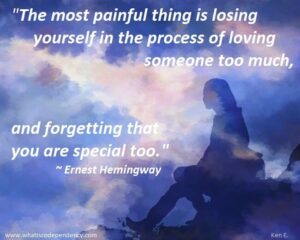 As codependents we lose ourselves in relationships, unaware that losing our Self is the greatest despair. When the relationship inevitably ends, it's devastating, because we are lost. We lack autonomy because that task wasn’t completed by adulthood. The struggle to achieve it is typical of codependent relationships. Often there are power struggles, characterized by repeated, unresolved arguments, either about a single recurring issue or numerous trivial things. Many of them boil down to the question of who has control, whose needs will be met, or how intimate they will be. Intimacy problems are a common symptom of codependency. Avoidance of intimacy, and the vulnerability that occurs when we open up, is a way to maintain control and autonomy. We fear that closeness makes us more dependent on our partner and exposed to being judged and hurt. These outcomes aren’t necessarily true, but hearken back to a traumatic or dysfunctional childhood when being vulnerable and dependent was unsafe. Some people feel unsafe both in and out of a relationship. The more we’re threatened by closeness and autonomy, the greater is the conflict in the relationship.
How We Lose Ourselves
We lose ourselves gradually in small imperceptible ways. It can start with romance, when it’s normal to want to please our loved one and spend much of our time together. However, emotionally mature adults don’t drop their activities, give up their lives (they have a life), or overlook improper behavior of their partner, despite strong physical attraction.
As codependents we lose ourselves in relationships, unaware that losing our Self is the greatest despair. When the relationship inevitably ends, it's devastating, because we are lost. We lack autonomy because that task wasn’t completed by adulthood. The struggle to achieve it is typical of codependent relationships. Often there are power struggles, characterized by repeated, unresolved arguments, either about a single recurring issue or numerous trivial things. Many of them boil down to the question of who has control, whose needs will be met, or how intimate they will be. Intimacy problems are a common symptom of codependency. Avoidance of intimacy, and the vulnerability that occurs when we open up, is a way to maintain control and autonomy. We fear that closeness makes us more dependent on our partner and exposed to being judged and hurt. These outcomes aren’t necessarily true, but hearken back to a traumatic or dysfunctional childhood when being vulnerable and dependent was unsafe. Some people feel unsafe both in and out of a relationship. The more we’re threatened by closeness and autonomy, the greater is the conflict in the relationship.
How We Lose Ourselves
We lose ourselves gradually in small imperceptible ways. It can start with romance, when it’s normal to want to please our loved one and spend much of our time together. However, emotionally mature adults don’t drop their activities, give up their lives (they have a life), or overlook improper behavior of their partner, despite strong physical attraction.
Stages of Codependency
Many codependents do fine on their own, but once in a relationship, the stages of codependency take hold. When there is “chemistry,” they overlook negative indicators that might be a warning not to get involved. It’s actually true that feel-good chemicals in our brain start to alleviate our emptiness, so that we want more of that drug. We don’t want to lose those good feelings. Hence, we become increasing preoccupied with and dependent upon our loved one. The desire to please can lead to obsession, denial about our partner’s behavior, and doubt about our own perceptions. Boundaries become blurred so that we don’t say “no” or set limits on what we’re willing to do or what we’ll accept from our partner. Not only that, confusion arises between what our partner feels and our own feelings. We feel responsible for them, too. If he’s sad, then I’m sad, too–as the Barry Manilow song goes. If she’s angry, it must be my fault. We’re confused (or never really knew) what we believe, what are our values and opinions. We may not have noticed this until we got involved in a serious relationship. In the middle stage of codependency, we give up our hobbies, outside interests, friends, and sometimes relationship(s) with our relative(s) to be with our partner. Usually, we do this willingly at the start of a relationship, but later may do so to comply with our partner’s wishes. Although our choices seem desirable or necessary, we’re not consciously aware of the price we pay: Our Self!Disease of a “Lost Self.”
This is why codependency is a disease of a “lost Self.” (See Codependency for Dummies.) Because our identity is referenced exte ally, we prioritize our relationships above our self, not occasionally, which would be normal, but repeatedly. In important relationships, we dread losing our connection with others or their approval. With our partner, we sacrifice ourselves over and over in small and big ways—from insignificant concessions to giving up a career, cutting off a relative, or condoning or participating in unethical behavior that before would have seemed unimaginable. A pattern of compliance develops and new norms are established, like the gradual restrictions on Jews in Nazi Germany. Over time, we build up guilt, anger, and resentment that’s often silent. We blame ourselves. Our self-esteem and self-respect, if we had any coming into the relationship, are whittled away. We become anxious and depressed, more obsessive and/or compulsive. We slowly give up choice and freedom until we feel trapped and hopeless, while our depression and despair grow. We may develop an addiction or physical symptoms. Eventually, we can become a shell of our former self.Abusive Relationships
Symptoms of codependency are exacerbated when we’re in an authoritarian relationship, where decisions revolve around the needs and authority of one person. This is typical of an abusive relationship, where our partner makes explicit demands. When our partner is insistent, it feels as if we have to choose between ourselves and our relationship—that we must give up our Self to keep it. We become invisible, no longer a separate person with independent needs and wants, assuming we knew what they were. To please our partner and not make waves, we give them up and collude in sacrificing our Self. Our relationship might be with an addict or someone mentally ill or with a personality disorder, such as narcissistic, borderline, or anti-social personality disorder. These partners are manipulative and can be abusive or threaten abuse or abandonment when they don’t get their way or sense that we’re becoming more autonomous. Any act toward autonomy, such as setting a boundary, threatens their control. They will attempt to maintain power and authority with guilt, character assassination, gaslighting, and all forms of criticism and emotional abuse. If you had a controlling parent, this pattern may have been established in childhood and carries over into your adult relationships. You end up walking on egg-shells and living in fear that can traumatize your nervous system, with symptoms continuing after you leave. It’s essential to get outside support and seek counseling. Healthy Relationships Healthy relationships are interdependent. There is give and take, respect for each other’s needs and feelings, and are able to settle conflict through authentic communication. Decisions and problem-solving are collaborative. Assertiveness is key. Negotiations are not a zero-sum game. Boundaries are expressed directly, without hinting, manipulation, or assuming our partner will read our mind. Neither security nor autonomy is threatened by closeness. Vulnerability actually makes us stronger, not weaker. In fact, we can be more intimate and vulnerable when our autonomy and boundaries are intact and respected. Both partners feel secure. They want to maintain their relationship and allow for each other’s separateness and independence, and aren’t threatened by their partner’s autonomy. Thus the relationship supports our independence and gives us more courage to explore our talents and growth. Recovery In recovery, we recover our lost self. Unaware of their codependency, people want to change their partner, not realizing that change begins within. Often our partner changes in response to our new behavior, but either way, we will feel better and stronger for it. Reading about codependency is a good beginning, but greater change occurs through therapy and attending Twelve-Step meetings, such as Al-Anon, CoDA, Nar-Anon, Gam-Anon, or Sex and Love Addicts Anonymous. In recovery, you will gain hope as the focus shifts from the other person to yourself, where change is possible. Raise Your Self-esteem, lea How to Be Assertive to express feelings, wants, and needs and to set boundaries. You’ll develop positive habits of self-care. Psychotherapy often includes healing PTSD, childhood trauma, and internalized or toxic shame. (See Conquering Shame and Codependency: 8 Steps to Freeing the True You.) Eventually, your happiness and self-esteem doesn’t depend on others. You gain the capacity for both autonomy and intimacy. You experience your own power and self-love. You feel expansive and creative, with the ability to generate and pursue your own goals. Codependency doesn’t automatically disappear if you leave a codependent relationship. Recovery requires ongoing maintenance. After a while, changes in thinking and behavior become natural, and the tools and skills learned become new healthy habits. Perfectionism is a symptom of codependency. There is no such thing as perfect recovery. Recurring symptoms merely present ongoing learning opportunities! ©Darlene Lancer 2018Article author
About the Author
Darlene Lancer is a Licensed Marriage and Family Therapist, author of Codependency for Dummies, and Conquering Shame and Codependency: 8 Steps to Freeing the True You. She's an expert in relationships, codependency, and addiction, having worked with individuals and couples for 27 years. She maintains private practice in Santa Monica, CA and coaches internationally. For more information, see http://www.whatiscodependency.com to receive a FREE Report, "14 Tips for Letting Go," and find links to her books and ebooks, including: "Dealing with a Narcissist," "How to Speak Your Mind - Become Assertive and Set Limits,""I´m Not Perfect-I´m Only Human"- How to Beat Perfectionism and "10 Steps to Self-Esteem: The Ultimate Guide to Stop Self-Criticism." Watch her Youtube, "Codependency: What It Is and What It Feels Like."
You can follow her on Facebook at http://www.facebook.com/codependencyrecovery
Further reading
Further Reading
Article
Live A Happy Married Life by Resolving Conflicts in Marriage
Param Pujya Dadashri and Hirabaâs married life was full of peace, mutual respect and humility. Their worldly conduct and interactions were idyllic, so much so that family and friends noticed their unity and love for each other. For instance, Hiraba would visit the local vegetable market daily, she would ask Param Pujya Dadashri, âWhat vegetables should I buy?â Thus, performing her duty of asking and He would reply, âBuy whatever you would like, therefore fulfilling Hi
April 3, 2025
Article
A Look at Avoidant Attachment Styles and How They Work
The early development of avoidant attachment creates a coping mechanism that forms in childhood. Disconnected parent-child interactions typically trigger this condition. People who develop this attachment style learn to depend on their resources. They avoid deep emotional connections. People with this attachment style want intimacy, yet they remain afraid of becoming dependent on others. Understanding Avoidant Attachment Among the four primary attachment styles, avoidant atta
February 6, 2025
Article
Do You Really Understand The Swinger Life-Style?
So, you want to Play swinging? Do you like the idea of having sex with several attractive people, with no strings attached? Want the chance to explore your fantasies with like-minded people? Love having the intimacy and long-term commitment of your partner, but don't want to miss out on the opportunity for sexual exploration and variety? If this sounds like something you'd like to try, the increasingly popular lifestyle known as 'swinging' could be for you. What's so shocking
August 29, 2024
Article
Best Swinger Websites for Couples Looking for Local Swingers
Even if you don't have a swing club near you, the online swinger dating website is a good choice for you. In recent years, online dating sites have become increasingly popular, and swinging has become one of the most popular lifestyles for married couples and bisexual people. If you are looking for a swinger couple, here are some swinger dating websites where you can enjoy an adult swing. Adult Friend FinderrnAFF is the worldâs largest sex community and swinger dating site.
August 29, 2024