Three Secret Behaviors of Narcissists
Reader stats
Article rating
New ratings
Reader rating appears publicly after enough eligible article ratings.
Rate this article
Sign in to rate this article.
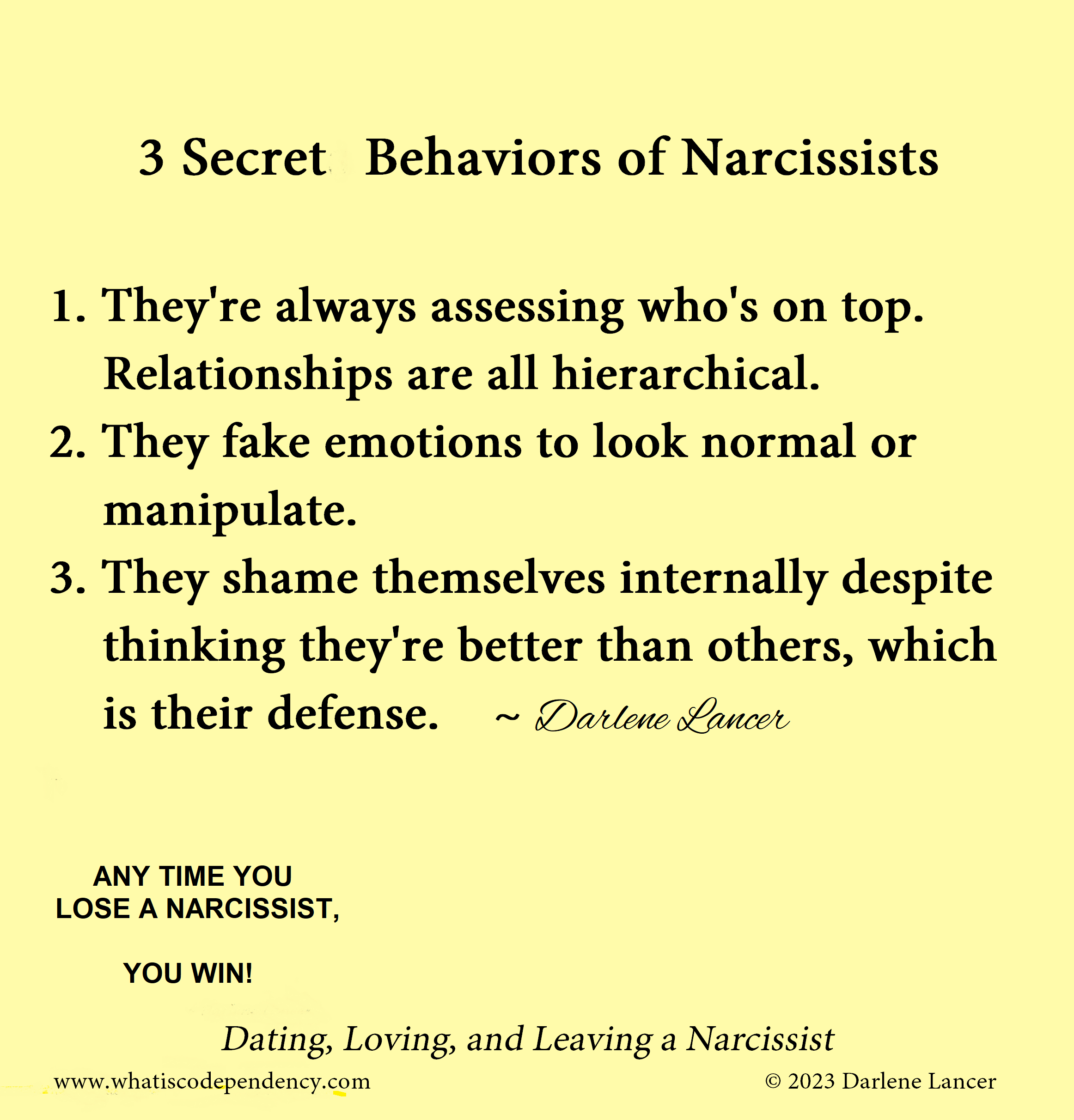
Narcissists’ entire personality is a defense to help them manage their hidden insecurity and inner turmoil. There are three secret behaviors they do that aren’t immediately obvious, but if you think about them, they would make sense to you and explain their manifest behavior.
These behaviors stem from core symptoms of narcissism, especially their lack of empathy and grandiosity, and also arrogance.
It's important in understanding narcissists to realize that their brain works differently and that they see the world much differently. Don't compare them to yourself.
A Hierarchical Existence
Having power is the primary preoccupation of a narcissist. In their mind, having control and being on top keep them safe. They can’t conceive of equal relationships and avoid environments where that is the expectation. To them, everyone is a predator or prey. They must be in charge or will be eaten. Thus, in every situation, they’re always assessing who’s on top, and try to be him or her. They use impression management to do this. They start with bragging and flattery, but when that doesn’t work, they try more aggressive tactics, such as belittling, manipulating, backstabbing, or cheating other people, or taking credit for their work.
Feelings Don’t Matter
If you’re not familiar personally with a narcissist, you might take what they say and do at face value. You might think they’re caring and generous because they give you a gift, or that they respect you because they compliment you. However, those close to a narcissist frequently question the sincerity of the narcissist in their life when they act as if they care about your feelings. They suspect ulterior motives, manipulation, and selfishness.
The fact is that many narcissists fake their feelings, because they don’t authentically know how to respond. They don’t see other people as individuals separate from themselves, nor have natural empathy. They never want to discuss feelings, particularly vulnerable ones. They never want to discuss feelings, particularly vulnerable ones. They learn how to respond by observation or manufacture feelings and responses to provoke a certain reaction in someone else. Even in the rare case that they might apologize for past behavior, they soon repeat the abuse or blame you for it without remorse or recognition of any contradiction. If you point it out, they might use DARVO or just blame you as if they never owned up to it before.
They Hide Their Shame
Although narcissists feel grandiose and better than everyone else, they don’t love themselves. Unde eath they worry they’re not enough or that they’re making mistakes. They may not be conscious of this underlying shame, just as many people are not, even though they may claim to have healthy self-esteem. Yet even when they do admit their insecurities to themselves or someone else, they don’t see the contradiction between that and their grandiosity. They may judge themselves for a bad decision or doing something foolish because they’re “so smart –“How could I do that?” The part of themselves that feels insecure is split off from the part of themselves that feels grandiose and superior. They then project aspects of themselves that they can’t accept onto others whom they disparage.
Learn more about the underlying features of narcissism, what motivates narcissists’ behavior, and explicit suggestions and strategies on how to respond to it effectively in "Dating, Loving, and Leaving a Narcissist: Essential Tools for Improving or Leaving Narcissistic and Abusive Relationships."
© Darlene Lancer 2024
Article author
About the Author
I'm a Licensed Marriage and Family Therapist and author of Dating, Loving, and Leaving a Narcissist: Essential Tools for Improving or Leaving Narcissistic and Abusive Relationships,"" Conquering Shame and Codependency: 8 Steps to Freeing Your True Self and Codependency for Dummies. and the 7 ebooks, including 10 Steps to Self-Esteem: The Ultimate Guide to Stop Self-Criticism, Spiritual Transformation in the Twelve Steps, ""I'm Not Perfect - I'm Only Human"" - How to Beat Perfectionism, Freedom from Guilt and Blame - Finding Self-Forgiveness, and How to Speak Your Mind: Become Assertive and Set Limits.
I've worked with countless individuals and couples for more than 35 years to recover from trauma and codependency. I'm an expert on narcissism, relationships, and codependency. See www.whatiscodependency.com and www.darlenelancer.com. See my website for FREE podcasts, meditations, and resources.
I've helped many individuals and couples find their way to more productive lives, happier marriages, and also to amicably separate.
My training includes psychoanalytic psychotherapy, EFT, family systems, trauma work, cognitive-behavioral, dream analysis, gestalt, and hypnotherapy.
I maintain a private practice in Santa Monica, and coach people internationally. See my website Service page for more information. Consultation by appointment: 310-458-0016. See my website to get a free report on 14 Steps for Letting Go.
Further reading
Further Reading
Article
Live A Happy Married Life by Resolving Conflicts in Marriage
Param Pujya Dadashri and Hirabaâs married life was full of peace, mutual respect and humility. Their worldly conduct and interactions were idyllic, so much so that family and friends noticed their unity and love for each other. For instance, Hiraba would visit the local vegetable market daily, she would ask Param Pujya Dadashri, âWhat vegetables should I buy?â Thus, performing her duty of asking and He would reply, âBuy whatever you would like, therefore fulfilling Hi
April 3, 2025
Article
A Look at Avoidant Attachment Styles and How They Work
The early development of avoidant attachment creates a coping mechanism that forms in childhood. Disconnected parent-child interactions typically trigger this condition. People who develop this attachment style learn to depend on their resources. They avoid deep emotional connections. People with this attachment style want intimacy, yet they remain afraid of becoming dependent on others. Understanding Avoidant Attachment Among the four primary attachment styles, avoidant atta
February 6, 2025
Article
Do You Really Understand The Swinger Life-Style?
So, you want to Play swinging? Do you like the idea of having sex with several attractive people, with no strings attached? Want the chance to explore your fantasies with like-minded people? Love having the intimacy and long-term commitment of your partner, but don't want to miss out on the opportunity for sexual exploration and variety? If this sounds like something you'd like to try, the increasingly popular lifestyle known as 'swinging' could be for you. What's so shocking
August 29, 2024
Article
Best Swinger Websites for Couples Looking for Local Swingers
Even if you don't have a swing club near you, the online swinger dating website is a good choice for you. In recent years, online dating sites have become increasingly popular, and swinging has become one of the most popular lifestyles for married couples and bisexual people. If you are looking for a swinger couple, here are some swinger dating websites where you can enjoy an adult swing. Adult Friend FinderrnAFF is the worldâs largest sex community and swinger dating site.
August 29, 2024