Why Reliance Multi Cap Fund Is the Best Choice in the Current Market?
 After recent SEBIs re-categorisation, the investors are suggested by the experts to invest in the multi-cap category. As multi-cap funds invest in different stocks across the market capitalisation, they are the preferred choice to take advantage of diversification. According to new mandates, the category should maintain an extensively diversified portfolio consisting of large-cap, mid-cap, and small-cap stocks. Reliance Multi-Cap Fund utilises the flexibility and manages a portfolio to produce sustainable returns.
About the Scheme
Reliance Multi-Cap Fund, previously known as <>Reliance Equity Opportunities Fund, was launched on 20th March 2005. The Reliance Multi-Cap NAV stands at Rs 95.95 (as on 19th Dec 2018), and have assets under management worth Rs 9,813 crore (as on 30th Nov 2018). The investors have to bear a 2.09% expense ratio if they invest in this scheme. Apart from this, it has maintained 17.89% annualised returns (as on 19th Dec 2018).
Why Is It the Best Choice in the Current Market? rnHere are the reasons making Reliance Small Cap Fund Growth the choice of investors in the current market situations.
Diversified Portfolio
Reliance Multi-Cap Fund maintains the diversified portfolio holding the large-cap, mid-cap, and small-cap stocks. It doesn’t invest in debt instruments, but keep a minimum portion which is less than 1% in cash equivalents. The significant allocation in equity instruments suggests that the fund manager invests a large portion of the corpus and keeps the minimum cash in the portfolio.
Analysing the portfolio, it has 49.30% assets in large-cap companies, 34.44% in mid-cap and 16.25% in small-cap companies. The fund manager doesn’t invest in different market caps according to the category and benchmark and follows his instinct backed by the research team analysis.
Portfolio Aggregates:
After recent SEBIs re-categorisation, the investors are suggested by the experts to invest in the multi-cap category. As multi-cap funds invest in different stocks across the market capitalisation, they are the preferred choice to take advantage of diversification. According to new mandates, the category should maintain an extensively diversified portfolio consisting of large-cap, mid-cap, and small-cap stocks. Reliance Multi-Cap Fund utilises the flexibility and manages a portfolio to produce sustainable returns.
About the Scheme
Reliance Multi-Cap Fund, previously known as <>Reliance Equity Opportunities Fund, was launched on 20th March 2005. The Reliance Multi-Cap NAV stands at Rs 95.95 (as on 19th Dec 2018), and have assets under management worth Rs 9,813 crore (as on 30th Nov 2018). The investors have to bear a 2.09% expense ratio if they invest in this scheme. Apart from this, it has maintained 17.89% annualised returns (as on 19th Dec 2018).
Why Is It the Best Choice in the Current Market? rnHere are the reasons making Reliance Small Cap Fund Growth the choice of investors in the current market situations.
Diversified Portfolio
Reliance Multi-Cap Fund maintains the diversified portfolio holding the large-cap, mid-cap, and small-cap stocks. It doesn’t invest in debt instruments, but keep a minimum portion which is less than 1% in cash equivalents. The significant allocation in equity instruments suggests that the fund manager invests a large portion of the corpus and keeps the minimum cash in the portfolio.
Analysing the portfolio, it has 49.30% assets in large-cap companies, 34.44% in mid-cap and 16.25% in small-cap companies. The fund manager doesn’t invest in different market caps according to the category and benchmark and follows his instinct backed by the research team analysis.
Portfolio Aggregates: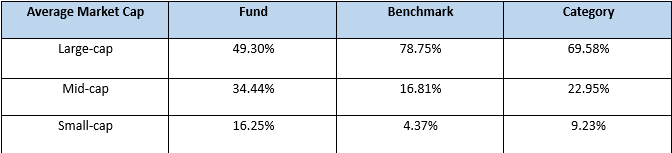 Flexibility to Move
Before investing in the large-cap, mid-cap and small-cap funds, it is necessary to analyse the category based on market condition. Multi-cap funds have that flexibility to move among large cap, mid cap and small cap stocks depending upon the market outlook. Reliance Multi-Cap Fund G also utilises this advantage and swings across different market caps based on the market conditions. For instance, when the valuation of mid-cap and small-cap stocks becomes expensive, the fund manager switches to large-cap stocks. Contrary to this, when the valuation of small and mid-cap are available at a lower value, the fund manager increases the investment bar in these categories.
The pure large-cap funds are restricted to invest a minimum of 80% assets in the large-cap stocks which are ranked from 1st to 100th according to market capitalisation. Moreover, the mid-cap fund has to maintain a minimum 65% assets in companies listed between 101th to 250th. As the fund manager of Reliance Multi-cap fund has the freedom to change the percentage of the corpus across large, mid and small cap stocks, the overall risk in the portfolio is mitigated in the long run.
Outstanding Outperformance
Flexibility to Move
Before investing in the large-cap, mid-cap and small-cap funds, it is necessary to analyse the category based on market condition. Multi-cap funds have that flexibility to move among large cap, mid cap and small cap stocks depending upon the market outlook. Reliance Multi-Cap Fund G also utilises this advantage and swings across different market caps based on the market conditions. For instance, when the valuation of mid-cap and small-cap stocks becomes expensive, the fund manager switches to large-cap stocks. Contrary to this, when the valuation of small and mid-cap are available at a lower value, the fund manager increases the investment bar in these categories.
The pure large-cap funds are restricted to invest a minimum of 80% assets in the large-cap stocks which are ranked from 1st to 100th according to market capitalisation. Moreover, the mid-cap fund has to maintain a minimum 65% assets in companies listed between 101th to 250th. As the fund manager of Reliance Multi-cap fund has the freedom to change the percentage of the corpus across large, mid and small cap stocks, the overall risk in the portfolio is mitigated in the long run.
Outstanding Outperformance The fund didn’t generate returns higher than benchmark and category in the last 3-years. Considering last 5-years annualised returns, it has produced adequate returns. For 7 and 10-years, the scheme has outperformed both the benchmark and category average with a wide margin.
Prudent Investment Style rnMr Sailesh Raj Bhan has been handling the portfolio since March 2005. He uses multiple aspects and free-flowing strategy to choose the stocks. The main focus of the fund analysts is on stocks which can show higher returns prospects. Mr Bhan uses his instinct for value proportions to maintain value tilt with a growth bias.
The reasons as mentioned above make Reliance Multi-cap Fund an important player in the current market situations.
The fund didn’t generate returns higher than benchmark and category in the last 3-years. Considering last 5-years annualised returns, it has produced adequate returns. For 7 and 10-years, the scheme has outperformed both the benchmark and category average with a wide margin.
Prudent Investment Style rnMr Sailesh Raj Bhan has been handling the portfolio since March 2005. He uses multiple aspects and free-flowing strategy to choose the stocks. The main focus of the fund analysts is on stocks which can show higher returns prospects. Mr Bhan uses his instinct for value proportions to maintain value tilt with a growth bias.
The reasons as mentioned above make Reliance Multi-cap Fund an important player in the current market situations.Further reading
Further Reading
Article
What Affects Truckload Shipping Costs?
Truckload shipping is a cornerstone of modern supply chains, responsible for moving goods efficiently across regional, national, and international networks. For businesses that rely on timely deliveries, understanding what influences truckload shipping costs is essential for optimizing logistics budgets and maintaining operational efficiency. Costs associated with truckload shipping can vary widely depending on several factors, from cargo type to route optimization. By analyz
January 7, 2026
Article
The Unlikely Call Center: Why the World is Dialing into Pakistan
Imagine itâs a typical Tuesday evening. Someone in a bustling North American city has a question about their internet bill. They pick up the phone, dial a familiar customer service number, and within moments, theyâre connected to a calm, articulate agent who resolves their issue efficiently. What the caller might not realize is that the helpful voice on the other end is speaking from a modern office in Lahore or Karachi, halfway across the globe. This scenario is playing
November 19, 2025
Article
How Qualified Solar Leads Can Improve Your Conversion Rate
Introduction: The Changing Face of Solar Sales In the fast-evolving world of renewable energy, the solar industry has witnessed remarkable growth. But with that growth comes competition â and not just for customers, but for the right customers. Many solar companies are discovering that chasing countless leads doesnât always bring better results. What truly matters is the quality of those leads. A well-qualified lead isnât just a number on a list; itâs someone genuinel
October 29, 2025