Michael Kewley
Dhammachariya, Awakened Master
Free
Meditation & Dhamma Expert
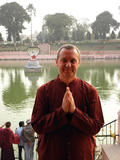
Michael Kewley Quick Facts
- Main Areas
- Freedom from fear through the meditation of 'Letting go' (Vipassana) and Loving Kindness (Metta )
- Best Sellers
- Buttons in the Dana Box, Walking the Path, The Other Shore, The Reality of Kamma.
- Career Focus
- Guiding Teacher of spiritual, Dhamma and meditation groups, Dhamma Speaker, Author.
Michael Kewley is the former Buddhist monk Pannadipa and founder of the Pure Dhamma tradition of Spiritual Awakening. He trained as a disciple for thirty years with Sayadaw Rewata Dhamma, a Burmese Buddhist master, both as a monk and a layman, and in his youth in the traditions of Rinzai and Soto Zen. He also spent time with Advaita Vedanta teachers in India, but now shares his complete spiritual understanding through the non dualistc presentation of Vipassana meditation and life-style. He was the senior teacher at the International Meditation Centre in Budh Gaya, India for many years and was known affectionately as ‘the guru with the loving heart’. He says often that he has no teaching to give, only Dhamma to share. On 26th May 2002 during a special ceremony at his masters temple in England he was awarded the supreme title of Dhammachariya, meaning master. Michael's method of teaching is through the use of stories, both traditional and modern and with great humour. To be in his presence is inspiring and profound, and everywhere in the world when he is present, Dhamma Halls are filled with the sound of joyful laughter.
Free Audio & Video Samples
Articles by this expert
SelfGrowth articles and saved writing connected to this expert.
Article
Chasing the peaceful mind
Meditating earnestly, the wise realise Nibbana, the highest happiness. Dhammapada Verse : 23 During one of our annual retreats at the International Meditation Centre, Budh Gaya, India some years ago, a young man from Holland came to me and said, ‘everytime I begin my meditatio I hear Beatles songs in my head, what should I do?’ I simply answered, 'let it be!' Hearing the song isn't important - it's singing along that brings the difficulties.
Recently added
Article
Dhamma in the family
Many, many years ago I knelt in front of my teacher and complained about my father, his attitude to me and his complete lack of understanding with my interest in Buddhism. He had recently said some things that had hurt me very much and even angered me. I needed to share that pain and find some support. My teacher listened while I poured my heart out about the current situation and finally when I had finished he smiled and said, rn‘Ah yes’, he said, ‘the Buddha had a lot of trouble with his father too.’
Recently added
Article
Self without Love
Human beings are a pretty strange and complicted life-force and although the potential for complete liberation is present in every moment, mostly we take the other route, that of suffering. One of the most common expressions of this suffering in the West is the bizzare pre-occupation with low self esteem. How did we arrive in this place where we continually think that we are no good, or at least not good enough, and then so often feel intimidated and threatened by everything around us ?
Recently added
Article
Prison Dhamma
The wise man will not look for the faults of others, or for what they have done or left undone. Rather he will look at his own misdeeds. Dhammapada verse : 50 Many years ago, whilst living on the Isle of Man, I was invited to present a Dhamma Talk at the local prison. I had become quite well known as a Buddhist practitioner and teacher, and then as now, always eager to serve the Dhamma, so I was happy to agree.
Recently added
Article
Being in balance
One of the qualities of spiritual progress is balance. This is achieved through the establishment of a calm and peaceful centre. Actually, this centre is not acquired by doing anything special, or by developing any particular talents or abilities, but by simply letting go of the minds natural tendency to operate in extremes.r
Recently added
Article
Dhamma is everywhere
Dhamma is everywhere My teacher arrived back at his monastery one afte oon after visiting his other monastery in London. He came straight to the kitchen where I, as a monk, was making a cup of tea. His smile was enormous and he said immediately, "Paññadipa, I have just heard my whole philosophy in a song on the car radio." (He was searching for a news station and bumped into pop music.) "Really," I said, "What was it?" "Don't worry, be happy," He replied. rn(Don't worry, be happy: Bobby McFerrin 1988)
Recently added
Article
Seeing the Buddha
Seeing the Buddhann He who sees me, sees the Dhamma, He who sees the Dhamma, sees me. Vakkali Sutta This short, but beautiful verse expresses completely our spiritual journey, and the goal ...
Recently added
Article
Free from the world
There is an old rule: The one who stays silent is criticised. The one who talks too much is also criticised. Even the one who speaks only a little is criticised. There is no-one in the world who is never criticised. Dhammapada: verse 227 Criticism is a part of our life, whether we give it or receive it, it is always there. For the one who gives it, it is a way to show power and control, for the one who receives it is a humiliation. However, it is a fact of life and no matter who we are or what we do, as long as we have life we will always be in the place to receive it.r
Recently added
Article
Living from love
Our usual way of being is to live in accordance with the rules and regulations set down by others. To play other people's games. They tell us what is right and what is wrong, and most importantly, how we should behave. This is simply conditioning by our parents, our educational system and society in general. At a very early age we learn that certain modes of behaviour are either acceptable or not. We loose spontaneous action, because in our mind we always trapped by this conditioning. A student of mine telephoned me one day to ask a question.r
Recently added
Article
Another place
At one time I was flying out of Heathrow airport to go to India and conduct our annual series of ten day Vipassana Retreats at the International Meditation Centre in Budh Gaya. It was a stormy evening and the sky was black with clouds and occasional lightning flashes, a good indication of what was to come.r
Recently added
Article
Changing places
Changing places At one time a student of mine was asking about my time as a monk in the Theravada tradition of Buddhism. He listened to my words and when I had finished speaking he said, 'Ah yes, but the monks life is a special life.' I answered, 'Not when you're a monk.When you are a monk that life is your ordinary life.’
Recently added
Article
Inside attachment
Whatever we are attached to will hurt us. It is well understood that attachment is the condition for our suffering and that whatever we are attached to will hurt us This attachment will always manifests in a possessive relationship with life and everything that it contains, and is revealed in the words ‘I, me, mine and my.’ When using these words without wisdom and understanding we open the gates to our unhappiness. The answer to the question, ‘who suffers ?’ is always the same, ‘I do !’ Attachment is always possessive, but what is it that we think we own ?r
Recently added
Websites & resources
SelfGrowth-published websites, downloads, and contributor profile websites connected to this expert.
Website
Pure Dhamma
Pure Dhamma is the return to the place where the Buddha offered his teachings of personal liberation for all before they were organised and collected in their many different styles and traditions.
March 8, 2011
Website
Pure Dhamma Teachings
Teachings and biography of Michael Kewley former Buddhist monk Pannadipa. Love, joy and wisdom.
September 23, 2007
Website
Pure Dhamma Teachings
Teachings and biography of Michael Kewley former Buddhist monk Pannadipa. Love, joy and wisdom.
September 23, 2007
Favorite Quotes & Thoughts from Michael Kewley
'Our purpose, through the practice of Satipatthana and Loving Kindness meditation is not to be holy or special, rather it is to be ordinary. To live in a simple way in the world, working, playing, spending time with our family and friends, and not deluding ourselves as being someone who is different. We do what we do because we are what we are. Not special, not different, but simply in harmony with our heart.' 'The moment we defend, support or rationalize violent action, whether through mind, body or speech, we have joined the ranks of the unenlightened and forgotten our heart. All the great masters, past and present speak of Love as the answer to all the difficulties of the world, but it is for true disciples of Dhamma to hear these words, not only with their ears, but with their heart and their whole being, and then apply them to their life.' 'Our spiritual life is our worldly life, and our worldly life is our spiritual life. We do not need to be meditating in a monastery or a cave in the Himalayas to train, we need only to raise the intention to change how we live. In this respect, the teaching is always around us.' 'To surrender into the reality of the moment is what will ultimately free us from the suffering of the moment. To be with things ‘as they are’, and ‘to be here now’, are all manifestations of the power of patience. If we are stuck in traffic or waiting for an appointment, being angry and impatient will not help us or the situation, but patient endurance will. This does not mean giving up our turn in the queue, but it does mean changing our attitude from ‘waiting’ to ‘simply being’. To cultivate patience by surrendering into the moment is the highest practice.' 'We're all born, we will all die, how do we fill that middle part? What is it that makes our lives worthy?'
Contacting Michael Kewley
How to get started
Visit www.puredhamma.org to know and understand the qualities of Michael. There are many books containg full meditation instructions readily available from the internet and bookstores. Live Teachings From Michael: Internet Vipassana Courses Internet Dhamma Talks Internet Dhamma Coaching Contact information at www.puredhamma.org A structured and guided course of meditation is available as well as CDs containing Dhamma Talks from various Retreats and Seminars. 'Michael's method of teaching is through the use of stories, both traditional and modern and with humour. To be in his presence is inspiring and profound, and everywhere in the world when he is present, Dhamma Halls are filled with the sound of joyful laughter.'
Other highlights
Anjaili with Michael On line Dhamma sharing for groups and individuals through the service of Skype. Details and prices from Dhammateacher@hotmail.com www.puredhamma.org